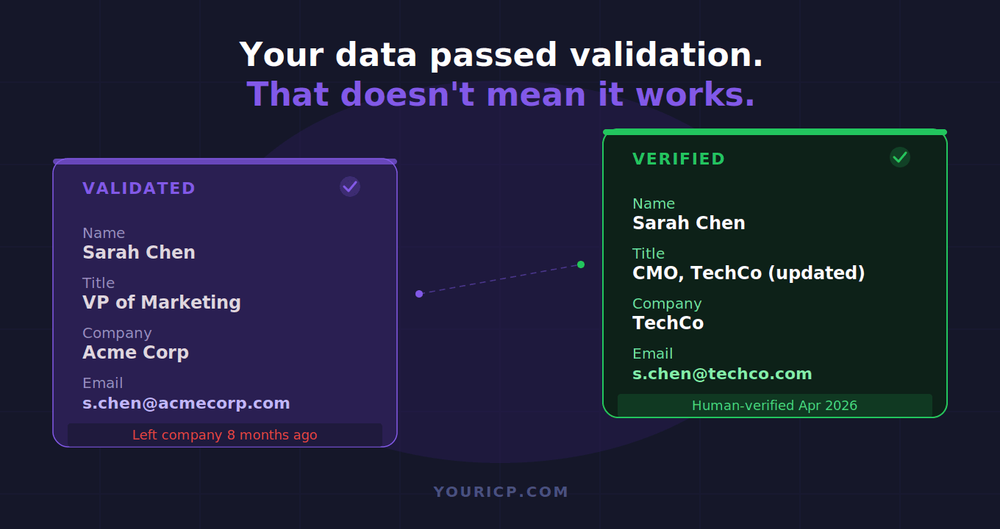
Most teams think they have good data because it's been validated. But validation and verification are not the same thing. That gap is exactly where contact data can break outbound performance.
These breaks can show up, and are easy to misdiagnose. Outreach that goes unanswered. Connect rates that quietly erode. Reps who spend hours working leads that were never going to go anywhere. When a contact record looks complete in the CRM but belongs to someone who left the company six months ago, validation gave you a false sense of confidence and your sales team paid the price.
Key takeaways
- Data validation checks that a contact field is correctly formatted. Data verification confirms the contact is the right person at the right company. They are not the same thing.
- B2B contact data decays 25–30% annually, meaning roughly one in four records in your CRM is already stale.
- Validated data looks identical to verified data inside a CRM. The difference only surfaces when you try to use it.
- When AI-powered outreach, lead scoring, and personalization run on validated-only data, decay compounds at scale.
- Moving to verified data requires a process change, not just a tool change: treat contact data as perishable, build re-verification cadences, and track usability metrics (connect rate, bounce rate) separately from field completion rates.
What validation actually tells you
Validation is passive. It checks whether a data point looks correct:
- Is the email formatted properly?
- Does the domain exist?
- Is the phone number structurally valid?
- Is the field populated?
These checks tell you the data could be right. They say nothing about whether it actually is. And yet most CRMs, MAPs, and enrichment workflows are built entirely on validated data. Teams look at a clean, fully populated database and assume it's ready to activate.
It's not.
What verification actually does
Verification is active. It confirms the data is right:
- Does this person still work at the company?
- Is this their direct number?
- Is this the best way to reach them right now?
- Have they recently changed roles, titles, or companies?
This distinction matters more than most teams realize. A record can pass every validation rule in your CRM and still be completely useless. Because the person left the company six months ago, the phone number routes to a front desk, or the title no longer reflects their actual buying authority.
Validation tells you the data looks right. Verification tells you the data is usable.
Why this gap is quietly destroying pipeline
B2B contact data decays fast. Estimates vary, but most put job change rates somewhere between 25–30% annually. That means in any given database, roughly one in four contacts has moved, changed roles, or changed companies in the last year alone.
When AI-driven outreach, lead scoring, and campaign personalization operate on that data, the decay doesn't stay quiet. It compounds.
- Outreach goes to the wrong person
- Scoring models prioritize stale accounts
- Personalization tokens pull incorrect titles and companies
- Connect rates fall
- Conversion drops
- Pipeline quality deteriorates. And no one can explain why.
The teams that struggle most with AI activation usually don't have a tooling problem. They have a data problem. Specifically, they've built their entire GTM motion on validated data and called it clean.
The real problem: most teams can't tell the difference
Validated data looks identical to verified data inside a CRM. Both records have a name, a company, an email, a phone number. Both pass your required field rules. Both show up in your segmentation.
The difference only surfaces when you try to use them. When the email bounces, the number goes dead, or the sequence books a meeting with someone who left the role you were targeting.
By that point, the damage is done. A rep has wasted outreach. A campaign has burned contacts. A scoring model has ranked the wrong accounts.
This is why data quality can't be treated as a one-time cleanup project. It's an ongoing operational requirement, especially when AI is involved.
What to do if you are only validating your contact data today
If your current workflow stops at validation, here are concrete steps to start closing the gap:
- Audit a sample of your "clean" records. Pull 100 contacts from your CRM that have passed validation including full name, email, phone, job title, company. Manually check 20–30 of them against LinkedIn. Count how many are still in that role at that company. The number will tell you more about your data health than any hygiene score.
- Separate your "populated" metric from your "usable" metric. Most CRM dashboards report field completion rates. That is a validation metric. Start tracking connect rate, bounce rate, and reply rate by data source and age. Usability shows up in outcomes, not fields.
- Flag records that haven't been verified by a human in the last 90 days. Automated validation on entry is not a substitute for periodic human review. Build a workflow that surfaces stale records for re-verification before they reach your SDR team.
- Prioritize mobile numbers for human verification. Up to 60% of mobile phone data sourced from public scraping is incorrect or missing. If your outbound motion relies on calls, this is the highest-leverage place to add a human check.
- Build enrichment cadence into your ops calendar. Data decay doesn't wait for your quarterly review. Set a recurring schedule, for example, monthly for high-velocity segments, quarterly for lower-touch lists, to re-verify records before major campaign sends.
- Evaluate whether your current provider verifies or just validates. Ask them directly: do humans confirm that a contact is the right person at the right company, or does your process stop at confirming that a contact method is technically functional? The answer will tell you how much of the quality gap you are carrying on your own.
The organizations that get the most out of AI-driven GTM aren't necessarily the ones with the most data. They're the ones whose data is continuously verified, close enough to real-time that decay hasn't had time to do meaningful damage.
The shift that changes everything
Most GTM teams are still operating on a static database model: enrich once, validate on entry, assume accuracy indefinitely. What AI-ready GTM requires is a living system of truth. One where data is verified on an ongoing basis, where records are flagged when signals suggest change, and where the gap between "what's in your CRM" and "what's actually true" is actively managed rather than ignored.
The teams that build that infrastructure will see measurably better connect rates, more accurate scoring, higher campaign performance, and more reliable pipeline.
The teams that don't will keep wondering why their AI tools aren't delivering. And keep getting the same answer wrong.
If your data isn't being verified in real time, it's already decaying. And your pipeline is feeling it.
That's exactly why we built YourICP. Our technology and workflows designed to verify data for our customers, not just validate it. We wanted to solve for these problems up front instead of leaving our customers to deal with the consequences down the line. You can see for yourself how your data stacks up with a free data hygiene analysis. It's a secure portal with no hidden fees, built to help GTM teams understand their contact data health and the best ways to fix it.